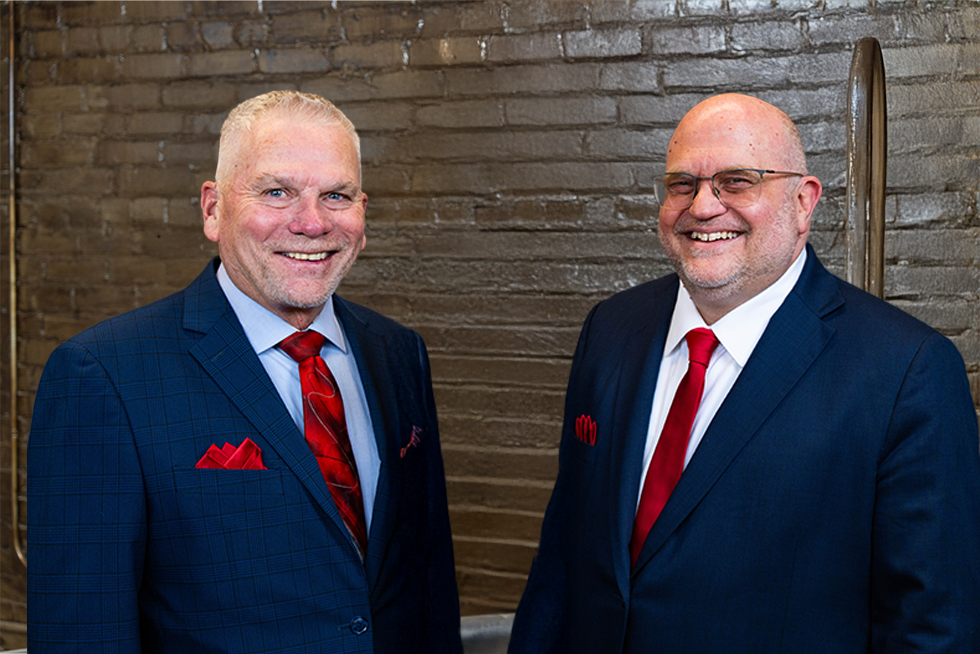
As President and CEO of the Los Angeles Regional Food Bank, Michael Flood brings a leadership philosophy shaped by his family’s Irish roots, competitive athletics, and a lifelong commitment to community service.

We explore how food banking has evolved from collecting surplus food to providing nutritious options suited to people’s circumstances. That evolution requires investments in infrastructure, disaster preparedness, and partnerships with organizations serving students, families, and people experiencing homelessness.

“There’s no one organization or entity that can do it all. … There’s no way we could do this work without this large army of volunteers.”

Michael Flood, President and CEO, Los Angeles Regional Food Bank

KBDB fish icon in blue

Michael Flood

President and CEO of the Los Angeles Regional Food Bank

Nate Springer is President and CEO of Care and Share Food Bank for Southern Colorado. He joins Dr. Phil Knight and Gerry Brisson to discuss how his military service shaped his approach to hunger, leadership, and organizational culture.

Nate shares how food banking challenged his assumptions about who experiences hunger, including teachers, nurses, military families, and working households. He also explains why he believes food security is national security.


Nate offers a powerful leadership lesson: give people clear direction, trust them to lead, and sometimes simply get out of their way.

His story ultimately reminds us that jobs end, titles change, and uniforms come off—but purpose doesn’t have a retirement date. Different mission. Different uniform. Same why.

“You never know what life is preparing you for.”

Nate Springer, President and CEO of Care and Share Food Bank for Southern Colorado

KBDB fish icon in blue

Nate Springer

CEO of Care and Share Food Bank for Southern Colorado

This is a powerful conversation about aging, dignity, independence, and why the destination of our work isn’t the doorstep.

The destination is the person.

Food insecurity among older adults is more complicated than simply having enough money for groceries.

Dr. Colleen Heflin and Dr. Madonna Harrington Meyer, authors of Food for Thought: Understanding Older Adult Food Insecurity, join Food Secure Nation to explore the often-overlooked realities that can make accessing food difficult as people age.

“They’d rather be hungry than homeless.”

Dr. Colleen Heflin and Dr. Madonna Harrington Meyer, Authors of Food for Thought: Understanding Older Adult Food Insecurity

KBDB fish icon in blue

Dr. Colleen Heflin is a professor of public administration and international affairs. She is also a senior research associate in the Center for Policy Research and a research affiliate in the Lerner Center for Public Health Promotion and Population Health. She has served as associate dean of the Maxwell School of Citizenship and Public Affairs and chair of the Public Administration and International Affairs Department.

Dr. Madonna Harrington Meyer is University Professor at Syracuse University.  She is professor of sociology at the Maxwell School of Citizenship and Public Affairs and Laura J. and L. Douglas Meredith Professor of Teaching Excellence. She is senior research associate at the Center for Policy Research, faculty affiliate at the Aging Studies Institute, and faculty research affiliate at the Lerner Center. She specializes in aging, care work and grandparenting in the U.S.

Dr. Colleen Heflin and Dr. Madonna Harrington Meyer

Dr. Colleen Heflin and Dr. Madonna Harrington Meyer

In the second of our two conversations with Feeding America CEO Denis McDonough, the focus turns from the person to the work—and to a strikingly optimistic premise: hunger in America is a problem we can solve.

Denis describes Feeding America’s strategic framework as both practical and impatient. Practical because the network already has the food, the people, the partnerships, and the infrastructure to make a difference. Impatient because families facing hunger cannot wait for systems to catch up.


At the center of the strategy is the neighbor. People experiencing hunger are not simply recipients of help; they are partners in creating solutions. That conviction shapes everything from food sourcing and fresh produce to measurement, accountability, and how the network defines success.

For Denis, success is not simply distributing more food. It is shortening the line.

The conversation ultimately becomes a case for moving beyond managing hunger toward solving it—by listening better, working together, measuring what matters, and scaling what works.

“We need to be impatient on behalf of those hardworking families that are fighting through hunger every day.”

Denis McDonough, CEO of Feeding America

KBDB fish icon in blue

Denis McDonough

Denis McDonough has spent decades in public service, including serving as White House Chief of Staff under President Barack Obama and as U.S. Secretary of Veterans Affairs. He has also held senior national security and congressional roles and worked in academia and strategic advisory positions. In April 2026, he became CEO of Feeding America, bringing his experience managing large organizations and public-sector initiatives to the fight against hunger.

Denis McDonough

Denis McDonough, CEO of Feeding America

Crystal FitzSimons has spent 27 years at the Food Research & Action Center believing something both simple and profound: hunger is solvable.

Now, as president of one of America’s most influential anti-hunger organizations, she is writing the next chapter of FRAC’s more than 50-year story.

Crystal joins Dr. Phil Knight and Gerry Brisson for a deeply personal conversation about the values that shaped her, why research and advocacy matter, the policies that can change lives, and the responsibility of leading an institution built by generations before you.

Along the way, she reminds us that behind every statistic is a family—and sometimes the most important thing we can do for children is simply make sure their parents aren’t parenting hungry.

This is a conversation about hunger, dignity, leadership—and why the next chapter matters.

“Hunger is actually a solvable problem”

Crystal FitzSimons, President of the Food Research & Action Center (FRAC)

KBDB fish icon in blue

Crystal FitzSimons

Crystal FitzSimons is President of the Food Research & Action Center (FRAC), one of the nation’s leading organizations working to eradicate poverty-related hunger and undernutrition.

During her 27 years at FRAC, Crystal has helped advance policies strengthening federal nutrition programs, including school meals, SNAP, WIC, and summer nutrition. Her career has been built around a fundamental conviction: we know how to address hunger—the challenge is building the political will to do it.

Today, she leads FRAC into the next chapter of its more than 50-year history, bringing together research, policy, advocacy, coalition

Denis McDonough

Denis McDonough, CEO of Feeding America

For more than four decades, Matt Habash, President and CEO, Mid-Ohio Food Collective has challenged traditional approaches to hunger relief, championing data, healthcare, technology, policy and community partnerships to address the root causes of food insecurity. In this episode, he reflects on a 42-year career of asking better questions and the belief that, “we’re not going to food bank our way out of hunger.”

Matt shares how asking better questions and challenging conventional thinking can change the way we address hunger. This conversation explores innovation, collaboration and what it takes to move beyond simply distributing food toward creating lasting change.

“At the end of the day, it was all about the same thing: Are we helping people or are we not helping people?”

Matt Habash, President and CEO, Mid-Ohio Food Collective

KBDB fish icon in blue

Matt Habash

Matt has served as President and CEO of the Mid-Ohio Food Collective since 1984, helping transform a traditional food bank into one of the most innovative food-security organizations in America.

Over four decades, Matt has pushed the work beyond food distribution—embracing data, healthcare, technology, public policy and community partnerships to better understand where hunger lives and what it will take to address its root causes.

His leadership philosophy is equally straightforward: listen, challenge assumptions, surround yourself with good people—and never stop asking how the work can be better.

Matt Habash

President & CEO, Mid-Ohio Food Collective

What makes a place home?

For Cyndi Kirkhart, CEO of Facing Hunger Food Bank, the answer can be found along the country roads of Appalachia—in communities where resources may be scarce, but resilience, ingenuity, and care for one another run deep.


In this episode of Food Secure Nation, Dr. Phil Knight and Gerry Brisson explore Cyndi’s remarkable journey: from inheriting a struggling food bank that might not make payroll to leading an organization serving 17 counties across West Virginia, Kentucky, and Ohio. Along the way, she challenges one of the oldest narratives about hunger: this work isn’t about filling empty bellies. It’s about supporting lives.

“Every plate has a story. Take hunger out of the picture, and imagine what becomes possible.”

Cyndi Kirkhart, CEO of Facing Hunger Food Bank

KBDB fish icon in blue

Cyndi Kirkhart

Cyndi Kirkhart is the CEO of Facing Hunger Food Bank in Huntington, West Virginia, serving 17 counties across West Virginia, Kentucky and Ohio. Over her 14 years of leadership, the food bank has grown from a team of 13 to more than 50 employees and now distributes more than 14 million pounds of food annually.

With a background in psychology, mental health and community service, Cyndi brings a deeply human-centered approach to food security. She is also a writer, poet and member of Feeding America’s National Advisory Committee, where she has been a strong voice for rural communities, smaller food banks and the people at the center of this work.

At the heart of her leadership is a simple belief: every plate has a story — and every person is worthy of being seen for far more than what they need.

Cyndi Kirkhart

Cyndi Kirkhart, CEO of Facing Hunger Food Bank

Gerry and Phil sit down with Virginia Witherspoon, the Executive leading Channel One Food Bank in MN.

She chairs the National Advisory Committee for Feeding America. Lawery, CEO and Chairperson – 3 Chairs, Unique Perspectives from Virginia Witherspoon.


What happens when one leader sees the food security system from three different vantage points at once?

In this episode of Food Secure Nation, Dr. Phil Knight and Gerry Brisson sit down with Virginia Witherspoon to explore how legal training, local leadership, and national governance intersect in a system under pressure.

From navigating post-pandemic resource challenges to rethinking how dignity shapes service delivery, this conversation offers a rare look at how real decisions are made—and what it will take to build a stronger, more aligned national response to hunger.

Dignity is free. It costs nothing to welcome someone well, trust them, and treat them like a shopper instead of a client.

Virginia Witherspoon

KBDB fish icon in blue

Virginia Witherspoon serves as CEO of Channel One Regional Food Bank and Chair of the National Advisory Committee for Feeding America. A trained attorney, she brings a unique blend of legal precision, operational leadership, and governance expertise to the fight against hunger. Her work is grounded in a deep commitment to dignity, data-informed decision making, and ensuring that the voices of people experiencing food insecurity shape the systems designed to serve them.

Virginia Witherspoon

Executive and Operational Leadership