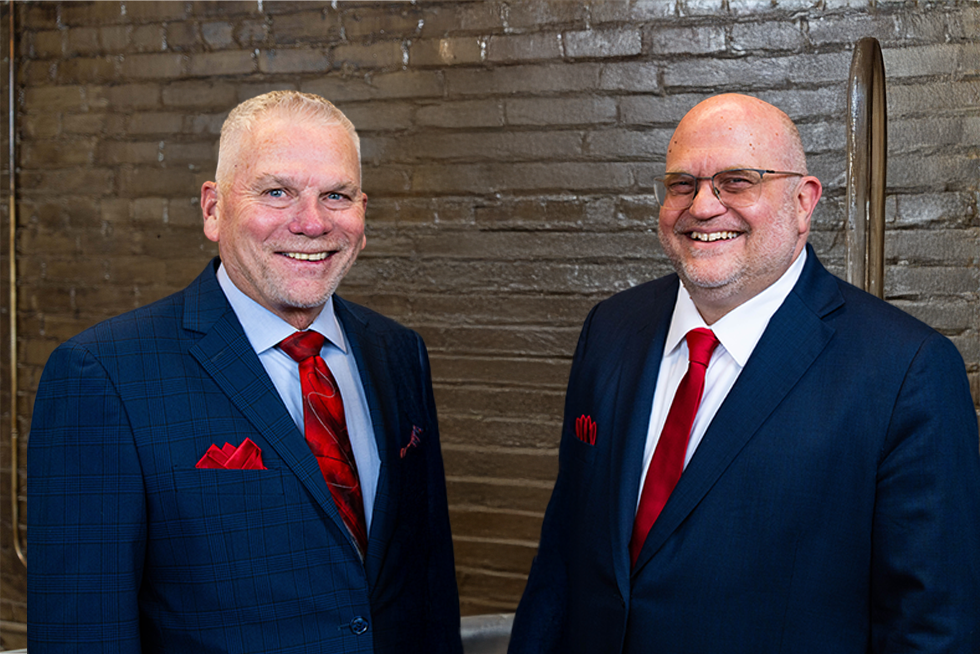
Dr. Phil Knight and Gerry Brisson sit down with Tory Martin, leader at the Dorothy A. Johnson Center for Philanthropy.

Our guest, Tory Martin, is a leader at the Dorothy A. Johnson Center for Philanthropy, where she helps study and interpret national trends shaping the nonprofit and philanthropic world. Her work looks beyond headlines to examine how trust, technology, and data are reshaping how nonprofits operate and how the public experiences their work.

The Six Dimensions Revealed

Although the Six Dimensions of Food Security were not explicitly named during the conversation, each one surfaced naturally through the lived experience, operational insight, and policy leadership shared by Dr. Phil Knight, Gerry Brisson, and Melissa Cherney.

Availability emerged through the practical realities of moving food across vast geography—from serving more than 70,000 square miles in North Dakota to leveraging federal commodity programs like TEFAP. The discussion made clear that food security begins with ensuring food is physically present in communities, whether through local purchasing, national procurement, or coordinated federal investment.

Access revealed itself through deeply personal stories. Both Melissa and Dr. Knight shared experiences navigating SNAP during seasons of vulnerability, highlighting the administrative burdens, eligibility thresholds, and bureaucratic friction that often stand between families and the assistance designed to help them. The conversation underscored that access is not simply about eligibility—it is about reliability, dignity, and trust in the systems that deliver support.

Utilization surfaced in the evolution of food banking itself. The shift from distributing whatever food could be recovered to ensuring the right food, at the right time, in the right quantities reflects a growing understanding that nourishment—not just calories—matters. Every household has unique needs, and effective food security must consider health, culture, and usability.

Stability ran throughout the episode in discussions of federal shutdowns, SNAP policy shifts, and the fragility of benefit continuity. When programs pause or change abruptly, families experience instability that erodes trust and planning capacity. Advocacy, even when imperfect, plays a critical role in protecting that stability and lessening harm.

Sustainability appeared most powerfully in the conversation about aligning food banking with local agriculture. By investing millions of dollars annually into local growers, food banks can strengthen regional economies while preventing hunger upstream. Food security and agricultural viability are not separate systems—they are interdependent.

Finally, Agency was woven through the personal narratives shared. Hunger was described not as an identity but as a circumstance. Applying for SNAP required courage; leaving it behind restored independence. At the national level, Melissa’s leadership of Feeding America’s Public Engagement Advisory Committee reflects collective agency—ensuring that those closest to hunger solutions have a voice in shaping policy.

Taken together, this episode demonstrates that the Six Dimensions are not abstract theory. They are already embedded in how thoughtful leaders approach hunger—intuitively, holistically, and systemically. When the dimensions align, communities move closer to the next threshold of food security.

Perhaps most encouraging, this episode demonstrates that the Six Dimensions are no longer theoretical constructs — they are becoming instinctive lenses through which experienced leaders evaluate policy, operations, and human impact.

Policy Impact

This Is What Leadership Looks Like

As Chair of the Public Engagement Advisory Committee for Feeding America, Melissa Cherney helps shape federal policies that impact families in every county in the United States.

From this conversation, three national imperatives rise:

Align Agriculture & Hunger Policy for Prosperity for All
Invest in farmers. Strengthen local economies. Prevent hunger upstream.

Safeguard and Evaluate SNAP but First Do No Harm
Stability builds trust. Trust builds resilience.

Create Program Alignment to Achieve Desired Outcomes
No one should lose food assistance because of bureaucratic misfires.

We are not here simply to move food. We are here to strengthen the system that determines who gets it, how much they receive, and for how long. That is how a nation becomes food secure.

KBDB fish icon in blue

Melissa brings a rare combination to the national stage:

  • Nearly two decades of food bank leadership—from the rural expanse of North Dakota to the densely populated communities of Rhode Island.
  • Firsthand experience with food insecurity as a college student navigating SNAP benefits.
  • A deep understanding that hunger does not define a person—it reflects a circumstance.

Her story reinforces a critical truth: hunger hides in plain sight. The face of food insecurity looks like any one of us.

Melissa brings a rare and powerful combination to the national stage. With nearly two decades of food bank leadership spanning the rural expanse of North Dakota to the densely populated communities of Rhode Island, she understands both the geographic and systemic realities of hunger in America. Her leadership is informed not only by executive experience, but by personal history. As a college student navigating a season of food insecurity and receiving SNAP benefits for a short time, she learned firsthand that hunger does not define a person—it reflects a circumstance. That lived experience did not limit her; it shaped her.

Her story reinforces a critical truth that echoes throughout the conversation: hunger hides in plain sight. The face of food insecurity looks like any one of us. It can be a farm kid from North Dakota, a struggling student trying to make tuition and rent work, or a working family navigating an unexpected disruption. This episode reminds listeners that the work of building a food secure nation begins with understanding the dignity, resilience, and agency of the people at the center of the issue.

Melissa Cherney

CEO of the Rhode Island Community Food Bank

Dr. Phil Knight and Gerry Brisson sit down with Melissa Cherney, CEO of the Rhode Island Community Food Bank and Chair of the Public Engagement Advisory Committee for Feeding America.

Together, they explore what real influence looks like in the fight against hunger—not headline-making power, but steady, principled leadership grounded in lived experience, operational excellence, and a national policy perspective

The Six Dimensions Revealed

Although the Six Dimensions of Food Security were not explicitly named during the conversation, each one surfaced naturally through the lived experience, operational insight, and policy leadership shared by Dr. Phil Knight, Gerry Brisson, and Melissa Cherney.

Availability emerged through the practical realities of moving food across vast geography—from serving more than 70,000 square miles in North Dakota to leveraging federal commodity programs like TEFAP. The discussion made clear that food security begins with ensuring food is physically present in communities, whether through local purchasing, national procurement, or coordinated federal investment.

Access revealed itself through deeply personal stories. Both Melissa and Dr. Knight shared experiences navigating SNAP during seasons of vulnerability, highlighting the administrative burdens, eligibility thresholds, and bureaucratic friction that often stand between families and the assistance designed to help them. The conversation underscored that access is not simply about eligibility—it is about reliability, dignity, and trust in the systems that deliver support.

Utilization surfaced in the evolution of food banking itself. The shift from distributing whatever food could be recovered to ensuring the right food, at the right time, in the right quantities reflects a growing understanding that nourishment—not just calories—matters. Every household has unique needs, and effective food security must consider health, culture, and usability.

Stability ran throughout the episode in discussions of federal shutdowns, SNAP policy shifts, and the fragility of benefit continuity. When programs pause or change abruptly, families experience instability that erodes trust and planning capacity. Advocacy, even when imperfect, plays a critical role in protecting that stability and lessening harm.

Sustainability appeared most powerfully in the conversation about aligning food banking with local agriculture. By investing millions of dollars annually into local growers, food banks can strengthen regional economies while preventing hunger upstream. Food security and agricultural viability are not separate systems—they are interdependent.

Finally, Agency was woven through the personal narratives shared. Hunger was described not as an identity but as a circumstance. Applying for SNAP required courage; leaving it behind restored independence. At the national level, Melissa’s leadership of Feeding America’s Public Engagement Advisory Committee reflects collective agency—ensuring that those closest to hunger solutions have a voice in shaping policy.

Taken together, this episode demonstrates that the Six Dimensions are not abstract theory. They are already embedded in how thoughtful leaders approach hunger—intuitively, holistically, and systemically. When the dimensions align, communities move closer to the next threshold of food security.

Perhaps most encouraging, this episode demonstrates that the Six Dimensions are no longer theoretical constructs — they are becoming instinctive lenses through which experienced leaders evaluate policy, operations, and human impact.

Policy Impact

This Is What Leadership Looks Like

As Chair of the Public Engagement Advisory Committee for Feeding America, Melissa Cherney helps shape federal policies that impact families in every county in the United States.

From this conversation, three national imperatives rise:

Align Agriculture & Hunger Policy for Prosperity for All
Invest in farmers. Strengthen local economies. Prevent hunger upstream.

Safeguard and Evaluate SNAP but First Do No Harm
Stability builds trust. Trust builds resilience.

Create Program Alignment to Achieve Desired Outcomes
No one should lose food assistance because of bureaucratic misfires.

We are not here simply to move food. We are here to strengthen the system that determines who gets it, how much they receive, and for how long. That is how a nation becomes food secure.

KBDB fish icon in blue

Melissa brings a rare combination to the national stage:

  • Nearly two decades of food bank leadership—from the rural expanse of North Dakota to the densely populated communities of Rhode Island.
  • Firsthand experience with food insecurity as a college student navigating SNAP benefits.
  • A deep understanding that hunger does not define a person—it reflects a circumstance.

Her story reinforces a critical truth: hunger hides in plain sight. The face of food insecurity looks like any one of us.

Melissa brings a rare and powerful combination to the national stage. With nearly two decades of food bank leadership spanning the rural expanse of North Dakota to the densely populated communities of Rhode Island, she understands both the geographic and systemic realities of hunger in America. Her leadership is informed not only by executive experience, but by personal history. As a college student navigating a season of food insecurity and receiving SNAP benefits for a short time, she learned firsthand that hunger does not define a person—it reflects a circumstance. That lived experience did not limit her; it shaped her.

Her story reinforces a critical truth that echoes throughout the conversation: hunger hides in plain sight. The face of food insecurity looks like any one of us. It can be a farm kid from North Dakota, a struggling student trying to make tuition and rent work, or a working family navigating an unexpected disruption. This episode reminds listeners that the work of building a food secure nation begins with understanding the dignity, resilience, and agency of the people at the center of the issue.

Melissa Cherney

CEO of the Rhode Island Community Food Bank

KBDB’s Influence

Food insecurity in America is not simple, and it is not inevitable. It is a complex, multi-layered, human-made challenge—spread across systems that too often operate independently of one another such as: health care, education, agriculture, philanthropy, and public policy.

Operating in silos we can accomplish a lot of good.  But without a shared understanding of community need, or a common way to measure progress, even good work can produce fragmented results and limited impact.

KBDB fish icon in blue

"The first responsibility of leadership is to define the problem."

— John Maxwell

Phil and Gerry reflect on what it means to lead in a way that actually produces change. At the heart of that approach is a commitment to meeting people where they are—not where we wish they were. They describe this as leadership by proximity: raising the relationship, honoring dignity, and solving real problems rather than imagined ones. It’s not about lowering expectations; it’s about grounding solutions in lived experience.

One truth anchors this discussion:

If you’re hungry, you only have one problem.

Hunger collapses everything else—learning, healing, working, parenting, and planning for the future. The episode is clear: people experiencing hunger are not lacking character, intelligence, or resilience. Hunger is the barrier. Remove it, and everything else becomes more possible.

The conversation then clarifies the relationship between the two platforms driving progress:

  • Food Secure Nation is the place to listen, reflect, and engage with leaders committed to building a food-secure America. It is a place where you can become familiar with all six dimensions of food security in a conversational and thought-provoking way, learning from people who are doing the work today.
  • Know Better Do Better (KBDB)—through com—is the learning hub that helps people go deeper: framing issues clearly, accessing credible research, and translating understanding into action.

Different tools. One purpose: moving the nation to the next threshold of food security.

Listeners are also introduced to Vera, KBDB’s AI partner—designed not to replace human judgment, but to support it. Vera helps surface reliable information, distinguish evidence from opinion, and meet people at the level of knowledge they need, whether they are just beginning or working at the highest levels of expertise.

The episode closes by introducing two core KBDB frameworks that will guide future conversations:

  • Four Levels of Knowledge: familiar, conversant, experienced, expert
  • Six Dimensions of Food Security: availability, access, utilization, stability, sustainability, and agency—with dignity running through all six

These frameworks exist for one reason: to help people understand where they fit, how they can contribute, and what it means to move from awareness to impact.

KBDB represents the next step in the work—not working harder in isolation, but thinking better together. Food insecurity was created by human systems. That means it can be undone—but only if leaders are willing to define the problem honestly, learn together, and act with intention.

Why Food Insecurity Still Exists in America

The United States has more than enough food in aggregate and one of the world’s most sophisticated food systems. Yet food insecurity persists year after year. The reason is not a single failure. It is a set of reinforcing pressures that keep many households one missed paycheck, one medical bill, or one rent increase away from running out of food.

This inaugural episode invites listeners to step back and look honestly at how our food system evolved. From the agricultural breakthroughs that made the United States a global breadbasket, to the birth of food banking as a way to distribute surplus, the system did what it was designed to do. But the world changed—and the conversation didn’t keep up.

Food Secure Nation exists to change that conversation.

This show begins with a simple but uncomfortable truth: food insecurity is something we created—and therefore something we can solve. Not with slogans. Not with blame. But with better thinking, better alignment, and better courage.

In America, 42 million people live with food insecurity. Not because we lack food—we waste nearly 40% of what we produce—but because access, systems, and priorities don’t line up. Hunger is visible. Food insecurity is quieter, more complex, and far more consequential.

Food insecurity touches everything:

  • A child’s ability to learn
  • A parent’s health and mental well-being
  • A worker’s productivity
  • A community’s stability

And yet, we often talk about it as if it’s someone else’s problem—or worse, a personal failure. It’s neither.

This is not a show about charity. It’s about responsibility. Not about guilt, but possibility.

Not about having all the answers but about asking better questions—together.

We believe dignity matters. Nutrition matters. Consistency matters. And solutions only work when they meet people where they are, without judgment. Solving food insecurity isn’t about doing more of the same; it’s about doing the right things, at the right level, with the right partners.

Our commitment is simple: to bring forward the evidence, the voices, the wisdom, and the urgency needed to prove that food insecurity in America can be solved—and to invite anyone who cares about their community, their workforce, their children, or their future to be part of that work.

Because hunger may be loud—but food insecurity is quieter, deeper, and more dangerous.

And when we know better, we can do better. That’s how we build a Food Secure Nation.

What the numbers say (recent years)

  • Roughly 12 to 14% of U.S. households (over 15 million households, about 40 million people) have experienced food insecurity in recent years.
  • The rate rose sharply after pandemic-era supports tapered and inflation surged: 10.2% (2021) to 12.8% (2022) to 13.5% (2023).
  • More than half of food-insecure households include a full-time worker, showing this is also a working-family issue.

SNAP participation reduces the likelihood of being food insecure by about 30%, but many eligible households are not enrolled, and benefits can fall short by month-end.


What it would mean to solve this

“Solved” means that every person can reliably obtain enough nutritious food in every season and region, including when shocks hit. In practice, that would look like:

  • Food insecurity becomes rare, not cyclical. Rates do not spike with recessions, disasters, or policy rollbacks.
  • Disparities narrow and then disappear. Households with children, single-parent families, and Black, Hispanic, and Native American households are no longer systematically more at risk.
  • Support systems catch people quickly. Short-term hardship does not become long-term instability.


Why it persists: a system that reinforces itself

Food insecurity is best understood as a set of linked loops. Low resources reduce food purchasing power. Food insecurity then increases stress and worsens health, which can reduce work capacity and raise expenses, deepening the original problem. Safety net programs counteract this loop, but gaps in access, adequacy, and coordination limit their ability to offset the pressures fully.

The evidence points to a consistent set of persistent barriers:

  • Low income and low wages: Households cut food first when money is tight.
  • High essential expenses: Housing, utilities, transportation, and healthcare costs force trade-offs.
  • Safety net gaps and shortfalls: Under-enrollment, eligibility limits, and benefit adequacy issues persist.
  • Administrative burden and stigma: Complex processes deter enrollment and consistent use.
  • Unequal burden across communities: Rates remain higher among Black, Hispanic, and Native American households.
  • Physical access barriers: Distance and transportation can make affordable, nutritious food harder to reach.
  • Fragmented governance: Programs seem to create gaps and diffuse accountability.


What’s changing now and the questions worth watching

Recent years have shown how quickly food insecurity can move when policy and prices change. Several changes are reshaping the landscape:

  • Policy whiplash as a driver: What happens when temporary supports expire, and which supports become durable over time?
  • The post-2021 SNAP benefit baseline is higher due to the Thrifty Food Plan update, but does it keep pace with local costs and end-of-month gaps?
  • Summer nutrition: With Summer EBT beginning in 2024 and more states adopting universal free school meals, will child food hardship stabilize outside the school year?
  • Access is evolving: SNAP online purchasing is now nationwide, but will delivery reach rural areas and households with limited digital access?
  • National ambition meets local execution: The federal goal to end hunger by 2030 is a strong signal, but which actors are accountable for measurable progress and equity in outcomes?


Why this matters for the conversation

If food insecurity were only about food supply, it would already be solved. The hard part is the system: income, costs, access, program design, and resilience through shocks. Bring your view of what is most underestimated, what is working, and where the real trade-offs show up in practice.

If our goal is a food secure America, changemakers need to consider all six pillars of food security when we think about our work.

The six-dimension model of food security is vital because it transforms food security thinking from addressing basic needs to fostering just, resilient, and sustainable food systems—ensuring both human well-being and ecological integrity now and in the future. It does not minimize the importance of providing basic needs. Rather, it enables broader thinking about the role of basic needs in light of systems that are beyond the control of basic needs organizations.

Spending time on this issue will help:

  • Program staff – develop language that puts basic needs in a proper light.
  • Public relations staff – provide language to tell the whole story of the community and the challenges of basic needs organizations.
  • Fund raising staff – deliver compelling case points.
  • Executive leadership – support organizational values beyond providing pounds of food and develop metrics that are outcomes, not just outputs; provide transparency and live by example.
  • Board of Directors – deliver clarity about values and outcomes.
  • Grant reviewers – uphold values common to many grant makers.
  • Funders of food security efforts – deliver set of ideas and specific ways to make a difference.


Values: Progress, Integrity
6-part food security scorecard: Access, sustainability

What is important about the six-dimension model of food security?

1. Comprehensive Scope

Adds Agency and Sustainability to the original four-dimensions.

  • Agency: Empowers individuals and communities to make decisions about what they eat, produce, and how they engage with food systems—recognizing food as a matter of human rights and democratic participation. [experience…arcgis.com], [researchgate.net]
  • Sustainability: Ensures food systems can continue to meet present needs without undermining future ecological, social, and economic foundations. [experience…arcgis.com], [researchgate.net]

In effect, this model reframes food security as a dynamic, rights-driven, and ecological concept—not just as the simple presence or affordability of food.


2. Reflects Real-World Challenges

  • Power Inequalities: Highlights the need for community empowerment in food choices and production—addressing issues of justice and equity. [researchgate.net], [we-do-change.org]
  • Ecological Resilience: Draws attention to environmental pressures—climate change, resource depletion, and biodiversity—that threaten long-term food systems. [researchgate.net], [fao.org]

These additions align the model with urgent global challenges like climate disruption and systemic inequity.


3. Enhances Policy and Governance

Incorporating agency and sustainability transforms how stakeholders—governments, NGOs, and donors—approach solutions by:

  • Shifting from emergency aid to rights-based interventions that empower communities.
  • Designing environmentally sustainable policies that protect ecosystems and livelihoods.

Promoting participatory governance, where communities help shape food system policies. [researchgate.net], [nj.gov]


4. Improves System Resilience

  • Stability addresses shock absorption (weather, economic, health crises).
  • Utilization ensures nutritional quality, safety, and proper absorption.

Combined with agency and sustainability, the model supports resilient, adaptable, and locally appropriate food systems. [experience…arcgis.com], [fao.org]

This multi-dimensional lens is especially useful in crises like the COVID-19 pandemic or geopolitical disruptions (e.g., conflict-induced supply chain shocks). [fao.org]


5. Aligns with Global Standards

The High-Level Panel of Experts (HLPE) of the UN Committee on World Food Security formally endorsed six dimensions in 2020, reflecting a consensus shift in global food governance. [we-do-change.org], [fao.org]

International bodies such as the FAO and CMCs support this wider framework, recognizing the importance of rights, equity, and ecological sustainability. [nj.gov], [fao.org]


Why it matters

  • Holistic Understanding: Food security is not only about “enough food”—it’s equally about who controls the food system and whether it endures for future generations.
  • Policy Alignment: Enables targeted, well-rounded policies that tackle immediate needs, structural inequities, and future risks.
  • Community Impact: Empowers communities, improves local governance, and fosters resilience—benefiting everyone from households to national systems.

Here are clear, current examples of how each of the six dimensions of food security is being effectively implemented in the United States:


1. Availability

Focus: Physical presence and supply of sufficient, nutritious food

  • Domestic production & supply chain resilience:
    The U.S. benefits from a robust food system; on average Americans spend only about 10–12% of their disposable income on food—a reflection of abundant, low-cost availability. [css.umich.edu], [ace-usa.org]
  • Per capita availability data:
    USDA’s Economic Research Service provides detailed metrics on national food availability across hundreds of commodities, offering insight into how much is produced and remains for consumer use. [ers.usda.gov]


2. Access

Focus: Economic and physical ability to obtain food

  • SNAP (Supplemental Nutrition Assistance Program):
    Serving over 41 million participants monthly, SNAP is the nation’s largest nutrition assistance program. In FY 2024, federal SNAP spending reached nearly $100 billion—benefits averaged around $187 per person per month.
    Research shows SNAP reduces food insecurity, poverty, and supports improved health, educational, and labor outcomes. [ers.usda.gov], [pewresearch.org] [cbpp.org], [frac.org]


3. Utilization

Focus: Nutritional intake, food safety, knowledge, and preparation

  • School meal programs:
    National School Lunch and Breakfast Programs serve nutritious meals to tens of millions daily. Updated nutrition standards (under the Healthy, Hunger-Free Kids Act) ensure meals include fruits, vegetables, whole grains, and low added sugar.
    These programs not only improve dietary intake but also boost academic performance, attendance, and healthier food habits. [heart.org], [cdc.gov], [fns.usda.gov] [cdc.gov], [schoolnutrition.org], [congress.gov]


4. Stability

Focus: Consistency of food access over time, especially during crises

  • TEFAP (Emergency Food Assistance Program):
    TEFAP distributes USDA-purchased American-grown foods to food banks, pantries, and soup kitchens, offering crucial support during emergencies and ongoing hardship. In fiscal 2024, $2.2 billion were allocated to TEFAP commodities and administrative support. [fns.usda.gov], [congress.gov], [feedingamerica.org]
  • D-SNAP (Disaster SNAP):
    Activated during federal-declared disasters, D-SNAP provides emergency nutritional aid when unexpected crises disrupt normal access. [usa.gov]


5. Agency

Focus: Empowerment and decision-making regarding food choices

  • Community gardens & People’s Garden Initiative:
    Community gardens empower individuals and neighborhoods through food production. Participants often see dramatic improvements: e.g., studies report up to a 90% drop in food insecurity and substantial increases in fresh vegetable intake.
    The USDA’s People’s Garden Initiative offers grants (e.g., $1 million since 2024) to support community-led sustainable agriculture, education, and local food empowerment. [community-…dening.org], [ifsffoodpantry.org] [fsa.usda.gov]


6. Sustainability

Focus: Long-term viability—environmental, economic, and social resilience

  • USDA’s Regenerative Agriculture Pilot Program:
    Launched in December 2025 with a $700 million investment, this initiative funds practices like cover cropping, conservation tillage, and whole-farm planning via EQIP and CSP. It focuses on soil health, water management, biodiversity, and nutrient density—to ensure long-term production without harming future ability. [agweb.com], [nrcs.usda.gov], [naco.org]

Founded by Gerry Brisson, Dr. Phil Knight, and Ryan Hoyle, Know Better Do Better is a modern approach to reaching the next threshold of food security.

Gerry Brisson

Founding Partner, Changemaker

Ryan Hoyle

Founding Partner, Changemaker

Dr. Phil Knight

Founding Partner, Changemaker

Leadership & Culture

Work on Clear Vision and Values based around the six dimensions of food security and the priorities of your organization.

  • Ensure leaders consistently communicate the organization’s mission and values regarding the role they play in the bigger picture of food security, acknowledging the importance of each dimension.
  • Identify opportunities to collaborate with others doing adjacent parts of the work for cross-organizational learning and development.


Dignity

Use examples to show how agency matters in the model and how lack of sustainability and stability affect dignity.

  • Don’t just chase money, chase things that matter both now and later.
  • Focus on respect, dignity, and non-judgmental communication.


Program

Be proud of what you do and aware of what you don’t do.  Encourage getting beyond one’s own scope and appreciating others doing different but adjacent work.

  • Tell the stories of people served.
  • Have concrete examples of work in each dimension and why it is important.
  • Thank somebody who is committed to work that is adjacent but different than yours.


Operations

Strategic Enhancements

  • Improve cross-functional collaboration: Break down silos between departments that work on different dimensions of the food security model.
  • Train and empower staff: Well-trained employees make fewer mistakes and adapt faster to changes.


Advocacy

Communication Tactics

  • Tell Stories: Personal narratives are more persuasive than statistics alone. Share real-life examples that highlight the impact of your cause.
  • Know Your Audience: Adapt your tone and content to match their values. Policymakers respond to data; communities respond to personal impact.

Practice & Prepare: Rehearse your message, anticipate objections, and refine your delivery.